
The Execution Gap: Why Companies Start to Struggle at Scale

Most companies don’t stall because they run out of ideas. They stall because, at some point, execution complexity starts rising faster than the company’s internal capacity to manage it. That slow, unglamorous widening is what we call the execution gap, and it’s the moment when growth stops feeling clean and starts feeling heavy. Teams are bigger, decisions take longer, dependencies multiply, and progress begins to cost more than it should. To anyone outside, the business still looks healthy. Inside, it feels strained.
If you’re a founder who has just crossed product-market fit and suddenly everything is harder instead of easier, this is for you.
What the execution gap actually is
The execution gap isn’t a dramatic event. There’s rarely a single quarter where it shows up on a dashboard. It’s a gradual distance opening up between what the company is trying to do and what it’s actually equipped to carry.
The product may still be strong. Demand may still be real. The team may still be highly committed. But value starts leaking quietly, in the spaces between functions, in the meetings that go slightly too long, in the decisions that take a week longer than they used to.
You see it in specific places:
- Meetings that produce more status updates than actual decisions.
- Leadership teams that spend more time reacting than prioritising.
- Founders who feel busy every hour of the day and yet aren’t sure whether the business is getting stronger or just getting bigger.
The reason the execution gap is so dangerous is that it’s easy to misdiagnose. Founders assume they need more people, more capital, more activity, more urgency. Sometimes that’s true. More often, what they actually need is more operating coherence.
Why early-stage playbooks stop working
In the early stages, momentum hides structural weakness very well.
A founder can compensate for missing processes with personal intensity. A small team can compensate for missing systems with constant communication. A limited customer base can compensate for messy delivery because the business is still close enough to every problem to patch it manually. In that phase, speed matters more than elegance, and that’s the right trade.
But growth changes the rules.
As more customers come in, more employees join, and more functions emerge, the cost of improvisation rises sharply. The founder can no longer be the single source of context. Teams can’t rely on hallway alignment anymore. Go-to-market becomes too important to be a collection of smart individuals doing their best. What worked because the company was small starts failing because the company is no longer simple.
This is not a rare problem. McKinsey research suggests that roughly 78% of companies that successfully reach product-market fit still fail to scale past it, and the reason is rarely the product. It’s the operating model underneath.
This is where the execution gap begins. And it tends to open up right after the most encouraging signals, not the worst ones.
The execution gap usually appears right after good news
This is the uncomfortable part. The execution gap doesn’t show up when things go wrong. It shows up when things go right.
The company is growing. Investors are interested. Customers are responding. The market seems to be validating the direction. Yet internally, strain is building. Product teams feel overloaded. Commercial teams want more support. Finance is trying to create visibility after the fact. And the founder is pulled into every important issue, often without realising it.
That’s not failure. It’s simply the point where growth starts demanding a more mature operating model. Scaling after product-market fit is a different job than finding it.
A quick diagnostic: are you in the execution gap?
If you recognise three or more of these, you’re probably already in it.
- You’re hiring more, but accountability feels blurrier, not sharper.
- Revenue is growing, but clarity about why it’s growing has actually shrunk.
- Every major decision still routes upward to the founder.
- GTM activity is rising, but conversion quality is inconsistent.
- Customers are coming in, but delivery and onboarding feel heavier every quarter.
- More capital feels necessary, not because the market demands it but because the internal system can’t cope.
- Meetings multiply, but decisions don’t.
None of these individually is a crisis. The problem is that they compound. And unaddressed, they quietly turn a promising scale-up into an expensive one.
Why founders misdiagnose the execution gap
When the gap opens up, the instinctive response is almost always to add: more headcount, more spend, more pipeline, more urgency. The theory is that momentum will fix it. Growth will outrun the problem.
It rarely does. Adding more to a system that’s already leaking value just means more volume leaking through the same cracks.
What most companies actually need at this stage is a handful of unglamorous things:
- Clearer decision rights, so people know what they own and what they don’t.
- Better cross-functional visibility, so the business can see itself clearly.
- Stronger handoffs between product, GTM, and delivery.
- A governance rhythm that helps decisions get made sooner, not later.
- An end to heroic effort as the default operating model.
None of this sounds exciting, and that’s exactly why it gets neglected. Startup culture still rewards visible momentum more than invisible maturity. Product launches, fundraises, and expansion announcements get the applause. Clear reporting, disciplined prioritisation, and clean execution interfaces between teams don’t. Yet those quieter things are usually what decide whether growth compounds or collapses under its own weight.
Closing the execution gap: the shift from founder-led to system-led scaling
A healthy scaling company isn’t just one that can grow. It’s one that can absorb growth without losing clarity.
That requires a real shift in how the founder thinks about the business. Instead of asking only, “How do we win more opportunities?”, the question becomes, “Is the company structurally ready to turn those opportunities into durable progress?”
This matters most right after product-market fit begins to emerge. PMF creates pressure. If the business isn’t ready, traction will expose weakness faster than stagnation ever could. Plenty of companies look fine when nothing is changing and only start breaking when things go well.
The best leaders catch this moment early. They don’t romanticise chaos. They don’t mistake adrenaline for performance. They understand the company has to evolve from founder-led to system-led scaling, and that this isn’t a loss of entrepreneurial sharpness. It’s how you protect it.
What changes when you close the execution gap
When a company becomes less dependent on improvisation, it gains something quietly powerful: repeatability.
- The team learns faster because feedback loops are cleaner.
- Decisions improve because information is easier to interpret.
- Bottlenecks become visible instead of absorbed.
- Accountability shifts from personal to structural.
- The founder moves from carrying the company to building it.
That last shift is the one that matters most. A founder stuck carrying the company has a ceiling. A founder building the company doesn’t.
The companies that handle this transition best are also the ones integrating modern tooling into the operating layer itself, which we’ve written about in more depth in AI adaptation and the new architecture of hyperscaling.
Why this matters more for European scale-ups right now
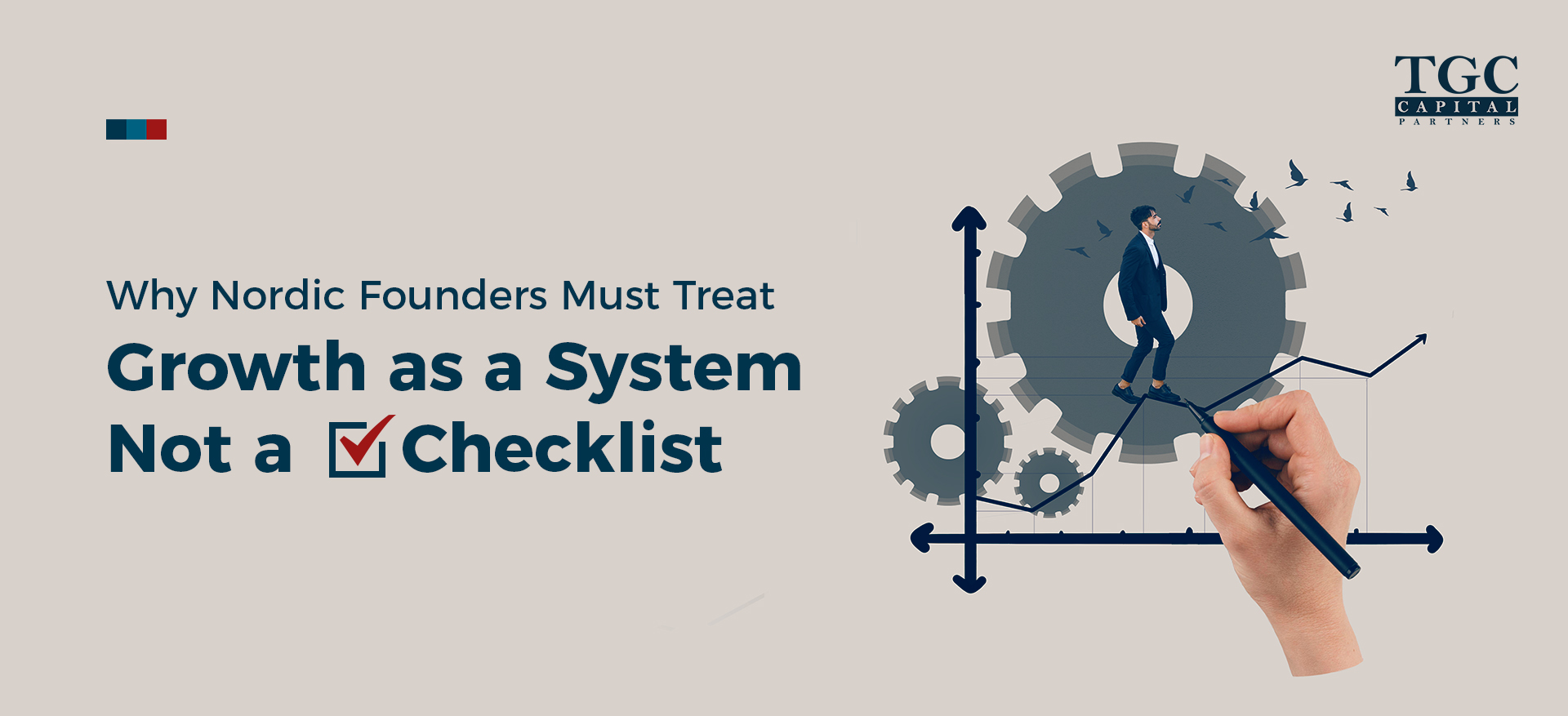
Many founders still approach sales, marketing, and business development as a checklist of tactics instead of an integrated engine, which is exactly why founders must treat growth as a system, not a checklist. Capital markets have tightened. Boards care more about quality of growth than loud growth.
That’s a healthier environment, but it raises the bar. Scaling a company in Stockholm, Copenhagen, Amsterdam, or Brussels in 2026 looks different than it did in 2021. You have less margin for sloppy execution and more reward for the teams that know how to build a predictable revenue system and a clean scale-up operating model before they pour fuel on top of it.
For founders asking how to scale a company without losing control, the answer usually isn’t more independence or more capital. It’s more structure, earlier than feels comfortable.
The real work of scaling
This is the part nobody puts on a pitch deck. Scaling isn’t growth at any cost. It isn’t performance theatre. It isn’t complexity dressed up as sophistication. It’s a steady, often unglamorous improvement in the company’s ability to execute with clarity as the stakes get higher.
Every ambitious business eventually faces the same choice. It can keep stretching the original operating model beyond its limits, or it can accept that scale requires design.
The first path produces rising friction and wasted capital. The second produces a business that moves with more confidence, more discipline, and considerably less drama.
In the long run, the companies that endure aren’t usually the ones with the highest chaos tolerance. They’re the ones that recognised, early enough, when it was time to replace heroics with structure.
And that, in a sentence, is what crossing the execution gap really means.
Ready to close the execution gap in your company?
TGC Capital Partners works with founders across globally to build scale-up operating models that hold up under real growth. If the pattern in this article sounds familiar, get in touch for a conversation.