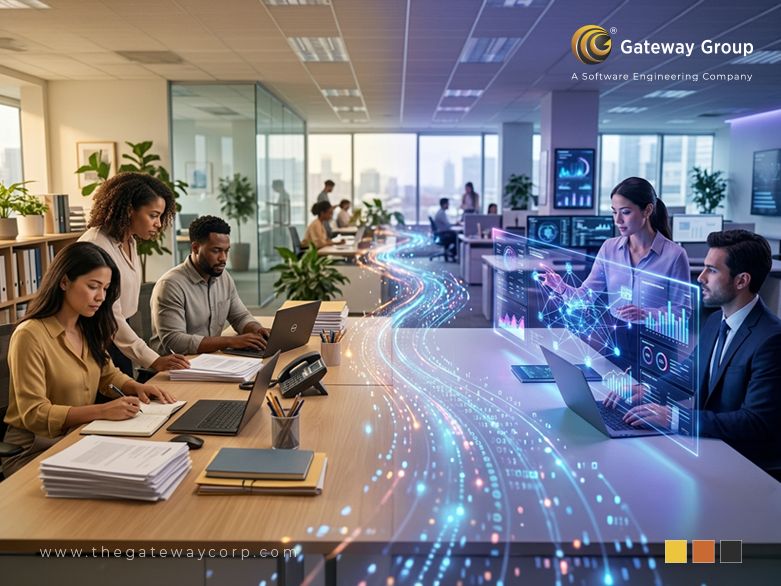
There is a structural shift underway in how modern organizations operate, one that goes beyond automation or incremental efficiency gains. At The Gateway Group, we see this as the emergence of AI-native workflows: a fundamentally different way of designing how work flows, decisions are made, and value is created.
For years, workflows have followed a fairly linear path, process, data, human decision. While effective, this model is limited by speed, scale, and the cognitive bandwidth of teams. AI-native workflows begin to change that. They still start with data, but instead of waiting for human interpretation, intelligence is introduced much earlier. AI systems analyze inputs, identify patterns, and suggest directions, while human involvement shifts toward validation, judgment, and strategic control. Over time, this creates a continuous learning loop, one that improves outcomes and refines itself with every cycle.
This shift is especially visible in how organizations engage externally. Traditional consulting and pre-sales approaches have relied on static knowledge, past experience, and periodic insights. In an AI-native setup, engagement becomes more dynamic. Conversations are shaped by continuously evolving intelligence drawn from cross-industry signals, delivery ecosystems, and real-time data. The result is not just sharper recommendations, but more contextual and credible discussions with clients. It moves the interaction from presenting solutions to co-creating them, supported by deeper insight.
For a global Software Engineering company like The Gateway Group, the impact extends into delivery. Managing distributed teams, multiple time zones, and complex dependencies has always required strong coordination. AI-native workflows bring continuity into this environment. Instead of reviewing projects at fixed intervals, systems continuously interpret progress. Signals around inefficiencies, dependencies, and risks are surfaced in real time, allowing teams to respond as work evolves, not after delays occur. What gets handed across geographies is no longer just tasks, but context-rich intelligence, helping execution stay aligned regardless of location.
Another important shift is moving from managing risk to anticipating it. In traditional systems, risks often become visible only after they start affecting outcomes. With AI-native workflows, early indicators, such as changes in velocity, resource strain, or collaboration gaps, are identified through continuous pattern recognition. This enables proactive intervention, turning risk management into risk foresight. In complex environments, this ability to act early becomes a clear advantage.
Internally, the transformation is even more significant. Knowledge is no longer static documentation but a living, interconnected system. Through semantic intelligence, information across projects, domains, and teams becomes easily accessible and contextually relevant. Teams don’t spend time searching for answers, they are guided to them. Alongside this, an AI-augmented workforce begins to take shape, where work is dynamically distributed between human expertise and intelligent systems. Routine tasks are handled efficiently, cognitive load is reduced, and human effort shifts toward higher-value problem-solving. Over time, this creates a self-optimizing environment, one that continuously improves without constant manual intervention.
At the same time, this shift requires a strong foundation of responsibility. Data governance, transparency, and compliance are not secondary, they are built into the system design. Frameworks like GDPR ensure that intelligence remains not only powerful but also trustworthy and scalable. At The Gateway Group, maintaining this balance between capability and accountability is central to how systems are designed.
Ultimately, AI-native workflows reflect a broader evolution in software engineering. Organizations are moving beyond building systems that simply function to building systems that think, learn, and adapt. Growth is no longer driven only by capacity, but by the intelligence of the system itself. Each interaction adds context, each cycle improves decision-making, and over time, the organization becomes more adaptive by design.
AI-native workflows are not a distant concept, they are already reshaping how high-performing organizations operate. At The Gateway Group, this is not an experiment or an add-on. It is becoming the foundation of how we design, deliver, and scale. Because the future of operations will not be defined by how efficiently processes run, but by how intelligently they evolve.
Explore further
Discover more Articles and stay in the know.